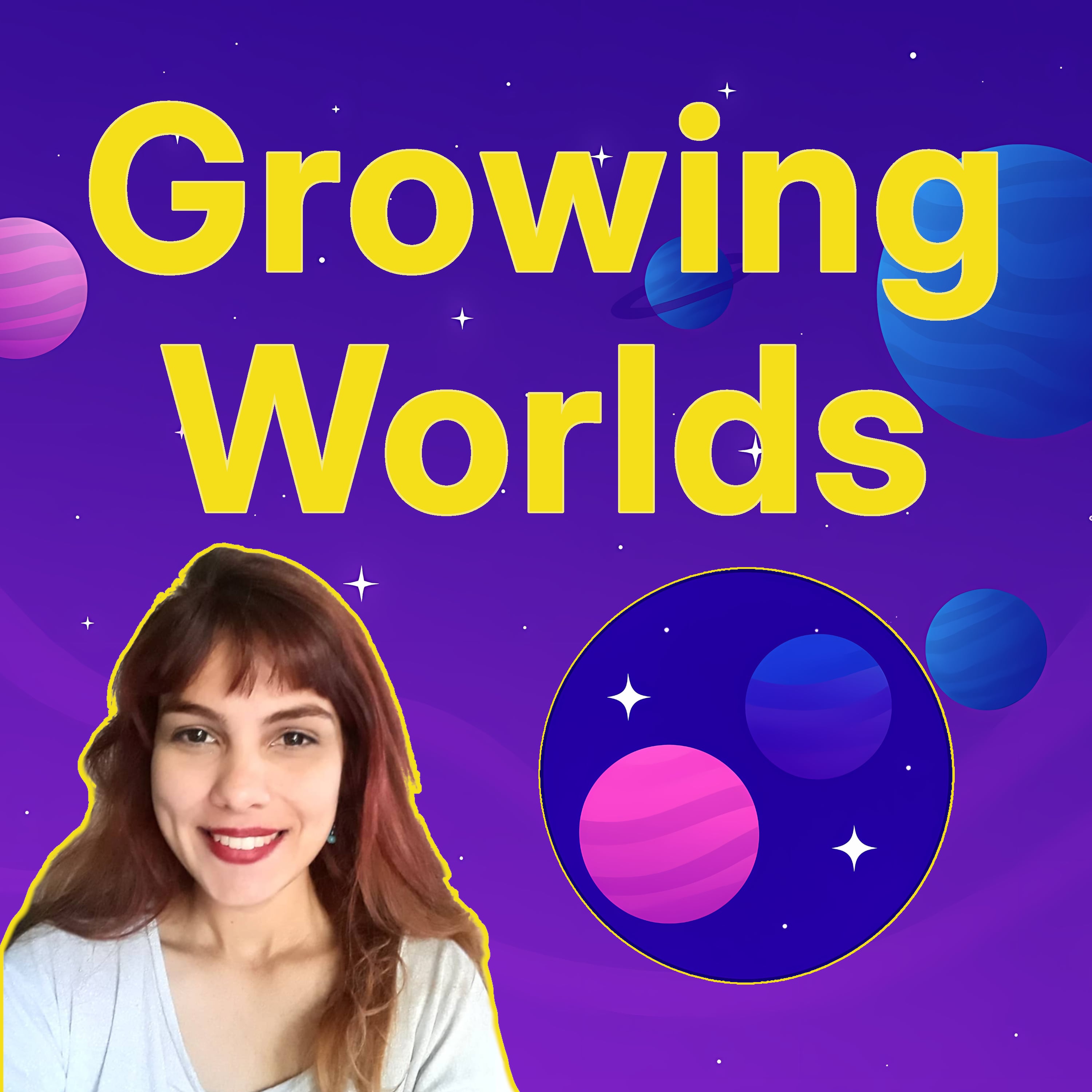
How exoplanets can save us: a chat with Dr Raissa Estrela
Featuring Raissa Estrela

Stay updated
Subscribe to our RSS feed
Transcript
Automatically generated — it may contain errors or misattributed speakers and can differ from what was actually said in the episode.
Welcome to Growing Worlds, the podcast where we explore the science of exoplanets through conversations with early career researchers on the front line of discovery. I'm Lorenzo.
And I'm Jenny. In each episode, we meet a guest who takes us behind the science of planets, stars, and the search for life in the universe.
Today we are taking a slightly different perspective, looking at how studying other planets can help us understand the one we call home. Because when we study exoplanet atmospheres, their chemistry, their temperature and evolution, we are also learning about climate, stability and the condition that makes any world habitable, including Earth.
To explore this fascinating connection between exoplanets and climate science, we're joined by Dr. Hayesah Estrella from NASA's Jet Propulsion Laboratory. Hayesah, welcome to Growing Worlds.
Thank you.
Aisa is a research scientist at JPL where she studies the atmosphere of exoplanets and how they evolve over time. Her work investigates how planets retain or lose the atmosphere under the influence of the host star, combining theory, models and observations from missions like Hubble or TESS. But Aisa also uses this planetary perspective to reflect on our own world, connecting the science of distant planets with the urgent questions of climate change here on Earth. And showing our observations from space can help us detect pollution, greenhouse gases and plastics on our planet.
So Hazer, before we get into the big picture about your research, it's always nice to talk about your origins. How did you get into astronomy? And then how did you end up studying exoplanets and their atmosphere? Was there a specific moment or was it a slow evolution?
Yeah, was some evolution. It was actually about almost 20 years ago. My goodness, I am getting old.
wow. our listeners can't see this because this is just an audio but like you don't look old, you look great so don't worry about it.
Thank you. Yeah, so back in high school, early 2000s, I was very interested about astronomy. I was not, to be honest, I was not very good at maths and physics. Not that it was not very good. I was not very interested in that. I was kind of lazy
You
and I really loved history. and biology and other stuff. And I had a history professor who came to the classroom with a book of Carl Sagan. And that book really changed my life. it's a very interesting book about, you know, the threat of pseudoscience and things like that. But it really opened my my eyes to the universe and to science, the
Mmm.
importance of science. And it really arose my interest in science. And from that moment, I started looking more into physics and I started to like more physics. I started to study more physics. And I thought, okay, this is actually interesting. And I decided
No.
that I really, was... probably going to the science career. I really like astronomy. My mom would notice that interest and she started to buy to me astronomy magazines. I'm pretty sure you guys are familiar with those. So I had
nice.
a collection
Mm-hmm.
of these astronomy magazines at my home. I still have them. but I was very worried also about our planet. So in the early 2000s, we started already here about, you know, the climate change and the know, the rise in the temperatures and the effects this could have in the future might not be the same awareness that we have today, but we started already have that notion back then. And I was worried, I'm very connected to animals as well. I like nature a lot. was raised in a house that's full of animals. My mom has an animal shelter.
So I was like, okay,
Aww.
I want to also take care of our planet, of animals. How can I do both? And there was no
Yes.
answer for that because in Brazil back then and still is like that today. You could only choose one thing to do in your whole life. So at 17 years old, I needed to decide what I was gonna do for my entire career. Am I gonna be an astronomer or am I gonna be an ecologist?
it's a big decision.
It's a big decision and you're very young, so you don't really know how to process that. So
Mm-hmm.
I decided actually that I was going to study ecology. So I went to university in another town, two hours from my hometown, and I started doing ecology.
And I started studying plants, going to the field, studying also the algae, know, going to the beach, collecting life forms to study them. And it was so
Yeah.
nice. I loved it a lot. But that astronomy thing was still in my head. like, I love astronomy.
yeah, That's the thing, once it gets in there, it's not leaving, it'll just stay with you for life.
We all know that hitch.
Exactly.
Yes!
Yes.
Yeah.
So I heard about something called astrobiology. And it was the connection between biology and astrophysics. I thought, oh, this is actually perfect for me. I want to do both. So how can I do this thing called astrobiology? So I left a note under the door of a professor in the physics department.
There was a professor there that was working with astrophysics and also exoplanets. So he was the only person that was starting to work with exoplanets. So I left a note under his dog saying, hey, I'm interested in astrobiology. I'm in the ecology department. I'm interested to talk with you about that. very nice. A note under the dog. He was knocking his dog.
Very brave move.
Wait, wait, wait. A note under the door. This is fantastic. This is new. Yeah.
Yeah.
Yeah, he was not in his office, so I left the note. He replied back to my email saying, yes, we can talk. So
Love that.
we chatted and he explained there was the Corolles mission, it was 2007. So the Corolles mission was going to launch, which was the first European mission, French mission, think the consortium with IZER, to be launched to look for planets outside of the solar system.
So before Kepler, before all that, so COHO was going to
Mmm.
launch, it was part of the COHO mission. And it said, oh, we know we're going to have all this data from the COHO and are you interested to work with me on that? And I said, yeah, I am. So I was doing ecology, but also doing research on astrophysics.
That's amazing that you
yeah, so.
are doing both at the same time.
Yes, I was doing both.
Yes. And then I decided, OK, I might, after two years doing ecology, and I loved it and also loved my work on exoplanets. it's like, but it might be the time for me to transition to physics because I'm doing most of my research here. So I did this transition. I left the ecology department. I went to physics department and I graduated in physics.
And from that moment on, my career was focused on exoplanets. I did a master, PhD on exoplanets,
Mm-hmm.
exoplanet atmospheres. And then almost 20 years later, we come back to me now, going back to ecology. So two years ago, I knocked on my other boss' and said, look, I am very concerned about our planet. I love astronomy. I love what I'm doing. But I would like to dedicate some of my time to also and my expertise to understand how can we solve the problems we have here in our planet. otherwise I can't sleep in good conscience. So he said, okay, let's see what we can do. And he connected me with other researchers at JPL, at the Jet Propulsion Laboratory. And I started to work with a mission.
an earth science mission that looks the reflected light from the surface of our planet, reflected spectra, and looks for signs of pollutants like greenhouse gases and also other pollutants like plastics. And we can see the signatures of these pollutants in the reflected light, which is pretty incredible. You can see if there is a huge concentration
That is incredible.
this. pollutants like methane, know, leakage from landfills or leakage from a gas pipe. You can see that. So we can identify
Wow.
these leakage, we can identify these point source emissions and we can help to mitigate them. So I started doing that. Right now I'm back to my old background of mixed environmental science and astrophysics because I'm still doing. as well exoplanets in exoplanets atmospheric studies. So that's it.
We say this a lot with
I think that's a...
Jenny, that life seems to go in circles, isn't it? It's fantastic.
Mm-hmm.
Yes. Yeah, it's kind
And it's also a beautiful message, the fact that you just need to knock a door.
Mm-hmm.
People are always happy to have you on board and give you the chance to follow what you want to do, which is something
done.
that we, as students, usually we don't see things this way, but it's actually how it is. Just knock a door or leave a note under the door.
Yeah, yeah.
beautiful.
And that, you know, even if you hate maths, you can still do space. I think that's like
Yes.
a strong message as well.
Yes, and sometimes you need a motivation, Like sometimes we see everything so, I know, like abstract. You don't really see the connection of that physics with whatever other part of the nature. But when you make the connection of that physics with the universe, for example, it sparkles something in your head like, that's actually,
Mm-hmm.
you know, it's here. It's part of our world. And it's very
Yeah.
interesting.
That's fantastic. So you said you went to exoplanet and then you move your eye toward Earth and now from space you are looking for this pollution point source, tracks of pollution on Earth. So can walk us through how you use the concept from exoplatary science to actually help understanding climate change or habitability in our home?
Yeah, think as astronomers we know better than anybody else that our planet is the only planet that's inhabited, right? We didn't find anything else in the universe that has life forms. Yeah, exactly. Yeah.
there is no playing the beat.
yet.
And we're planning missions for that. We're planning, we have the Habitable Worlds mission. part of this mission. We're planning a mission to be launched in the 2040s.
to detect signs of life. So we're trying to go for it. But yet, so far, planet Earth is the only one. And we are the golden model for habitability. So I think nothing better than understanding our planet if we want to understand how life has evolved and how we can find life in other planets as well. So although my work on Earth science so far has been very focused on understanding pollutions, right, on detecting pollution, we can also look in the earth science as well in understanding the evolution of life, right? And there is also this extra-mophiles life that lives in very extreme environments. And so many things that we really don't really know very much about life itself, how life, you know, survive it or how life evolves in these very extreme places. And all the different species that we have in our planet. We even forgot that we live, we share this planet with thousands of other species, right? It's incredible
Yeah.
the biodiversity of life that we have in a single planet. And it would be incredible, of course, to find such a thing in other planet. But so far, this is the only model and we should take advantage of it, right? Should take advantage of understanding how we arrive in such a biodiversity point.
Right, from a single fly cell to all these incredible animals, plenty,
Yeah.
fungi, all kinds of life forms, algae that are here. One of them are here for billions of years. We humans have been here only for the last 100 million years, right? So we are very recent in the life chain, in the life tree, but there are so many other forms that we need to understand how these forms evolved to arrive to this point, right?
So I think we have a history that we should take advantage of that to understand for habitability outside. And also, of course, in our own benefit, right? Because right now we are living in a climate threat, And as astronomers we should take that knowledge to understand, you know, We arrived to this point of having such a rich biodiversity and we are endangering it. We are losing it so fast. How can we prevent
Yeah. Yeah.
that? How can we keep the life that we have here while we also find life outside of our planet, right? We want to do both.
Yeah.
So I think astronomers better than anybody else have this perspective of life and of the universe.
Yeah. So how do you study
So.
Earth and figure about the different changes that are happening in our atmosphere and our climate by using tools and techniques from exoplanet science? What are you using exactly from studying other worlds in order to sort of study our world?
well, there is an overlap in the expertise and the technique, which is basically physics, right? It's going to be applied to many others. can be exoplanets, can be earth science, which is called spectroscopy. So basically, we are seeing,
Okay.
we are decomposing the light, right, in many wavelengths. In this case, in the earth science, the mission that I work with is looking to this reflectance spectra. So the reflected the surface of our planet.
And we're going to do the same in a few years from now with the Habitable Worlds mission, actually. So we're going to look into the reflected light from all the planets. So it's pretty cool that what we do in our planet right now, we're going to be applying in a few years from now to other planets as well to see the reflected
you say reflected spectra, let's help our listeners here. You mean the light that is coming from the host star, in our case is the Sun, right? It
Yes.
hits the planet and then is reflected and then from that reflectance you can understand something about...
Exactly.
Yeah, how does that work? How does stuff get encoded into that reflected light?
Yes, that's a good question. So what is in our atmospheres or in the surface of the planet? They can interact with the light. So for example, water in our atmosphere, let's use the atmosphere as an example for now. We have oxygen, we have water, we have methane, and all these molecules, they can interact with the light that comes from the sun and that's going to reach them in the atmosphere. So they interact with the light.
Okay.
in a very specific color or wavelength, as we are going to say in science, right? And again,
Mm-hmm.
they're going to absorb that light and we are going to see the reflectance in a very specific color associated to that molecule. So we call that signatures because each molecule has a specific signature in this reflectance of the light. for example,
Okay.
we know like where we want to see the oxygen. it's going to have a very specific wavelength, methane another one, and so on the water. And sometimes they can overlap actually, the signatures can overlap
Yeah.
and that's when it becomes tricky for detectability because when you don't know how to distinguish is that, you know, is this water or is that oxygen, you know, so it could have an overlap between bands. that's basically how we can detect in other planets.
we can look into these specific signatures in the reflected light, which is associated to a molecule.
Yeah, so the with the reflected light, is it like absorption lines or emission lines for the different molecules or is it both? Absorption lines.
Yeah, absorption lines. Yeah, you're to see the absorption lines from these molecules. And the same way you can see, you can do for the surface reflectance spectra. So you have also, when the light reaches the surface of the planet, it can interact with the components that are in the surface. So you can have,
Okay.
for example, in our planet, we have the greenhouse gases. And these greenhouse gases, can also absorb the light in a specific color, in a specific to see that interaction with the light in the reflectance spectrum.
Yeah.
So that's what we look for.
And to say you are applying the same techniques to Earth, but the Hubble World Observatory, it's going be applied also to other planets.
Correct, yes. The habitable is going to be applied to other planets. We're still planning that because it's way different right here. When we look at our surface, we are looking into an image and each point of this image has a signature, you know, has a spectra. So it's a very high
Yeah.
resolution. which is different from the habitable worlds, you're going to have a single pixel for the entire planet. So, you know,
Nyehehehehe
Okay.
And it's going to be very tricky to disentangle all the signatures of what is in that planet, right? Because you're going to have the atmospheric signatures and you're going to, you could have the surface signatures all in one single information, one single spectra. So...
It's way more challenging. And we are trying to understand now what is the instrumentation that we need with this observatory in order to detect, for example, if you want to detect biosignatures, right? Because they are the signatures that are related to life in our planet, like oxygen, ozone, methane. Those are the main ones and water, course.
Those are the main ones. So we're trying to understand what is the abundance we need, what is the instrument specifications that we need in order to detect these biosignatures in the atmosphere of a planet that's very far away.
Okay, so it's like the earth studies and they're gonna enable us to then study the worlds elsewhere with habitable worlds. But have the worlds elsewhere ever revealed something about earth's atmosphere? Has it ever sort of gone the other way where we've had like some sort of weirdness in our atmosphere that we've never been able to explain and then we're like, we've seen it in other worlds or something like that.
I other worlds could help us to understand maybe the history of our planet as well, right? Because
Hey.
we don't really know much. I mean, we have some knowledge of what was the past of the primitive Earth. There are some indications that back in the Archean period, like billions or four billion years ago.
We didn't have oxygen. We had mostly methane and nitrogen in our atmosphere and CO2, but no oxygen. Oxygen came later when the photosynthesis started in cyanobacteria that were in the ocean, started to release oxygen to our atmosphere. So the oxygen build up. But before that, we had an atmosphere that was completely different. So we had also other life forms. So our planet.
It was basically an alien planet for us as we see that today, right? So it's a completely different environment
Okay.
Of course.
that we don't really know. And maybe if we look to other planets that are maybe, you know, could have the same stage as a primitive Earth, we could understand more about our past. So I don't think we're going to understand much of our present with these other exoplanets,
Okay.
but it will help us to understand about our past. and how also the influence of the star, because we're going to look into many solar type stars, and how these stars are influencing
Okay.
the atmosphere environment of that planet. So I think it can really help us to understand evolution, even evolution of life, right, if we find something that's vindicated of pre biosignature. So biosignatures of primitive Earth that we might be seeing these other planets.
we are thinking about that. When you're planning this mission, you're thinking about that. We think not only about the Earth as it is today, but we think about
Mmm.
Earth as it was in the past. And what was it like
Yeah.
in the past of the primitive Earth? What kind of signatures we had in the past? And what we could see in these planets. So we need to think of Earth as a whole from that very primitive to now,
yeah, I've never thought about how exoplanets could help us understand our past and how actually Earth got to this rich biodiversity that we have today. Because yeah, it's such a good point that billions of years ago, our atmosphere was completely different. And like imagine if we find, you know, exoplanets that have a same atmosphere as we think early Earth had and then like...
on that curse for transition where they're just starting your very weak oxygen signals as like oxygen is starting to build up and that is absolutely fascinating that's brilliant
We always say that astronomy is kind of archaeology because you're looking in the
you
past because the light takes time to get to us so we are actually
Mmm.
looking in the past. But this is really looking in our past as well. I've never thought about it. It's really, really cool.
Yeah, I think, yeah, it's gonna, we have a very promising feature ahead of us with all these observatories, especially, I mean, we have the
Mmm.
space observatory like Habitable Worlds, and also the IELTS, right, the Extreme Large Telescopes, which is gonna also enable us to look into rocky planets, which is something where we're not very, able right now. We have James Webb, but James Webb is very good to understand more larger planets, but smaller planets we are going to enter in that area with the extreme large telescopes and also with these upcoming observatories.
So with habitable worlds, will it be looking at it's sunlight stars, but with small rocky worlds that are orbiting in the habitable zone, so they're gonna be taking approximately a year to orbit. Is that the kind of target?
Yeah, the goal is actually to directly image 25 Earth-like planets, so planets that are in the habitable zone of the solar tap star. Of course,
Wow.
that's the goal. It doesn't mean that we're going to reach that.
Mm-hmm.
but that's the goal. And we have, there is a lot of studies already with catalog of solar type stars that are promising to observations. We don't really
Yeah.
know how many of them have habitable zone planets, but we're going to be trying to find that.
Yeah, I guess this time right because did you say it was 2040s that it's launching?
Yeah, it's about around that.
Yeah, so there's time to kind of get the extra knowledge with other telescopes eminently coming online and things like that.
Yeah, yes, and it's time to get the knowledge about the planets that we could get and also about the stars as well. So there are a lot of people that starting monitoring these stars, right? Because the stars, they can be very temperamental as well, right? We know that they are
Hehe.
Hahaha
active. They can have flares, they can have spots, and all that can also compromise observations sometimes and also even have capability.
so by studying sort of exoplanet atmospheres, have we realized anything particularly special about Earth's atmosphere, You know, its composition, it's, I mean climate is changing, but generally it's been quite steady for a long time. Is our atmosphere like quite unique?
We don't know yet. I think that's the question we're going to be answering that we want to answer for these future observatories like habitable worlds. But so far, yes, our atmosphere is quite unique because we have oxygen, have methane. Both oxygen and methane originating from life. So we don't see that, of course, in any other...
planet outside of the solar system or even in our solar system, right? So, so far, yes, it is very unique and it's very special. It's what makes us
Yeah.
be here today talking and briefing because we have oxygen. The other planets in our solar system, it's interesting because we have Venus, which is our like our Earth twin. It has the same size as Earth, the same density as Earth, but a completely different atmosphere. Venus has a very
Yeah.
big cloud layer, A very thick CO2 layer. So has this crazy greenhouse gas effect taking place. That's a warming the surface. It's basically a hell planet. Of course, we are not
Mmm.
going to have the same greenhouse gas. We don't have such a thick atmosphere, but we are having a greenhouse effect that's warming our planet. So that was used to bring awareness. So, yes, so just to answer your question so far, we are unique in our composition because we have all these elements that coming from life.
So because you say that this our atmosphere is so unique, so it's so rare, do you think from a communication point of view that exopatary science can help us inspire people to, well, they're more care about our own planets and about the problems that you are telling us about?
Yeah, definitely. 100%. I think that's very important for us to, even if we find others, I mean, I think with the deceptive world going to even tell if our planet is very rare or
Yeah.
it's going to tell otherwise. But even if it it's rare, it's still very important finding, right? Because we should take even more care about our planet. which we are not doing great job right now
No.
So that's just to emphasize the importance of it, right? Because as a species of this planet, we sharing this planet with many other species, but we are the only species that did not understand how to collaborate and how to cooperate because we live in an
Mm.
ecosystem. So the planet, the atmosphere, is just one component of the ecosystem.
So everything is connected. We know that. We know about the water cycle, the nitrogen cycle. The surface is connected to the atmosphere. We study that for exoplanets. We are actually going, this is a field that's increasing the exoplanet actually to study more the interaction between the surface, the interior of the planet
Mmm.
and the atmosphere. everything is connected. We as a species, we're just one single component of all the system that's connected. But we didn't understand during these hundred million years that we are here, human species, we did not understand that we are part of this system. So we breaking it
Yeah.
apart, which is very dangerous. That's exactly what we don't want. We can't break the ecosystem because once we relieve the equilibrium, things start to go out of control. That's what we're seeing.
that's knowledge that we need also. We are seeing with exoplanets when we study about equilibrium chemistry, the equilibrium in other atmospheres and how things are connected. Even if there is no life, we understand that there is a connection between the interior, the surface and the atmosphere. Same thing here, but we have life. also life is part of this connection as well. And we need to act as such a thing. We are We are really not.
But even the most absurd life like plants, all the life forms, they understand that. They understand they're part of that
Yeah.
system. They are doing their contribution. But we who are called to be the intelligent species, we are not.
Yeah, because it's like, you know, volcanoes will release carbon dioxide. So there's your like connection to the ground. And then we've got, like you said, the trees and they're like absorbing the carbon dioxide and giving out oxygen and yeah, everything is in this fine balance. And then we're coming along and just doing exactly what we want to do.
Yeah, and everything is recycled, right? Even the residues, everything
Mmm.
finds a way in nature to be recycled and we don't do that. We waste things to the atmosphere or to the oceans, right? To the rivers, like if it was somehow disappeared, but not like that. Nature doesn't work like that.
Yeah, but the thing is we can fix it, like we're aware of it now and we know what we're doing and so now we can start fixing
Exactly. Exactly. We
so if there are any students or early career researchers listening who want to help fix it and work at this intersection of exoplanets and climate, what would your advice be for them?
Yeah, I think it would be very interesting to study under different climate scenarios, in exoplanets, how things could evolve for
Okay.
habitability, for example, right? We have very different conditions around other planetary systems. the luminosity might be a little bit different. The star might be more active, might have more flares, these crazy magnetic eruptions.
So the climate conditions might be different and that might tell us a little bit about how the planetary conditions could be in that system. So I think there are so many things to explore on exoplanets, like in terms of climate. Or you can even explore different atmospheric conditions and see how that would evolve for an exoplanet.
Mm-hmm.
What could that imply for life as well?
And we can also take the history of our planet and apply also to other planets to understand how that could be. That's actually what we do right now for detectability. We basically take the story of our planet to understand how that could reflect in detectability in other exoplanets. The planet is so much more far away from us, right? How could we see those signatures of life? and also...
Other signatures that are not related to life from the primitive Earth throughout the history of our planet, could we see that in other planets that are so far? If they had it, could we see that?
Yeah.
there are so many things and also as I say, like climate, know, like Venus, for example, and Mars are planets that could have been habitable, but they are not. So how can
Mm.
we take that knowledge away? Why these planets did not work out? Why life did not evolve in these planets? These are great examples to understand a little bit about our own planet, right? Why we
Yeah.
work it out, but they didn't. So even in our
Yes.
solar system, we don't need to go so far away. Even in our solar system, we have these two examples that we need to understand more. We don't really know.
And maybe there are all these possibilities that we see that there is water in Mars, there are probably rivers in Mars, so maybe there was life back in the days in Mars. We have the Perseverance rover, they are trying to look more into evidence of it.
But Venus is a little bit more tricky, right? Because it has this very thick atmosphere. So people are trying to look into signs of life in the atmosphere of Venus, because that's a possibility
Yeah.
as well. So I think this is two very mysterious cases that we have that are neighbors and we don't really know it.
Yeah.
Imagine outside of the solar system, much have so much more cases like that. And that would be very useful to understand, you know, why life work it here, but not there.
This is really fascinating. have like thousands of follow-up on this. I would
Yeah.
like to explore in so many directions, but unfortunately, and really unfortunately, we're getting to the end of our time together. So before we wrap up, I want to ask you our signature question. So if
Okay.
Mm.
had to choose one celestial body, which could be a star, a planet or something else entirely that represents you, what would it be and why.
That's easy one for me. Definitely Planet Earth is the one that represents me, It's our home.
Yeah.
and it's the one that, you know, it's so fascinating. I'm really a big fan of our planet. I know we have our problems here, but we also have this amazing diversity of life. And I find so fascinating every time I see, you know, I go.
I travel or I go to my home country in Brazil, I see all these mangroves, all the forests and the tropical forests, all here in the US when I travel and I go to Yosemite, Sequoia and you see these big trees and thing is possible.
wow, bring us video please. Bring us video in one of these trips.
Yeah.
It's just fascinating to me the amount of species that is in a single planet, know, how can, how we achieve it, how this planet achieve it to become what it is. It's just fascinating and it's really definitely my favorite place.
That's fantastic, guys, so thank you very much for your time, for being with us, for reminding us that by studying distant worlds we are also learning how to take care of our own.
Thank you.
And thank you to everyone listening. Join us next time on Growing Worlds as we explore another corner of the universe and the people bringing it closer.